C minor chord on piano
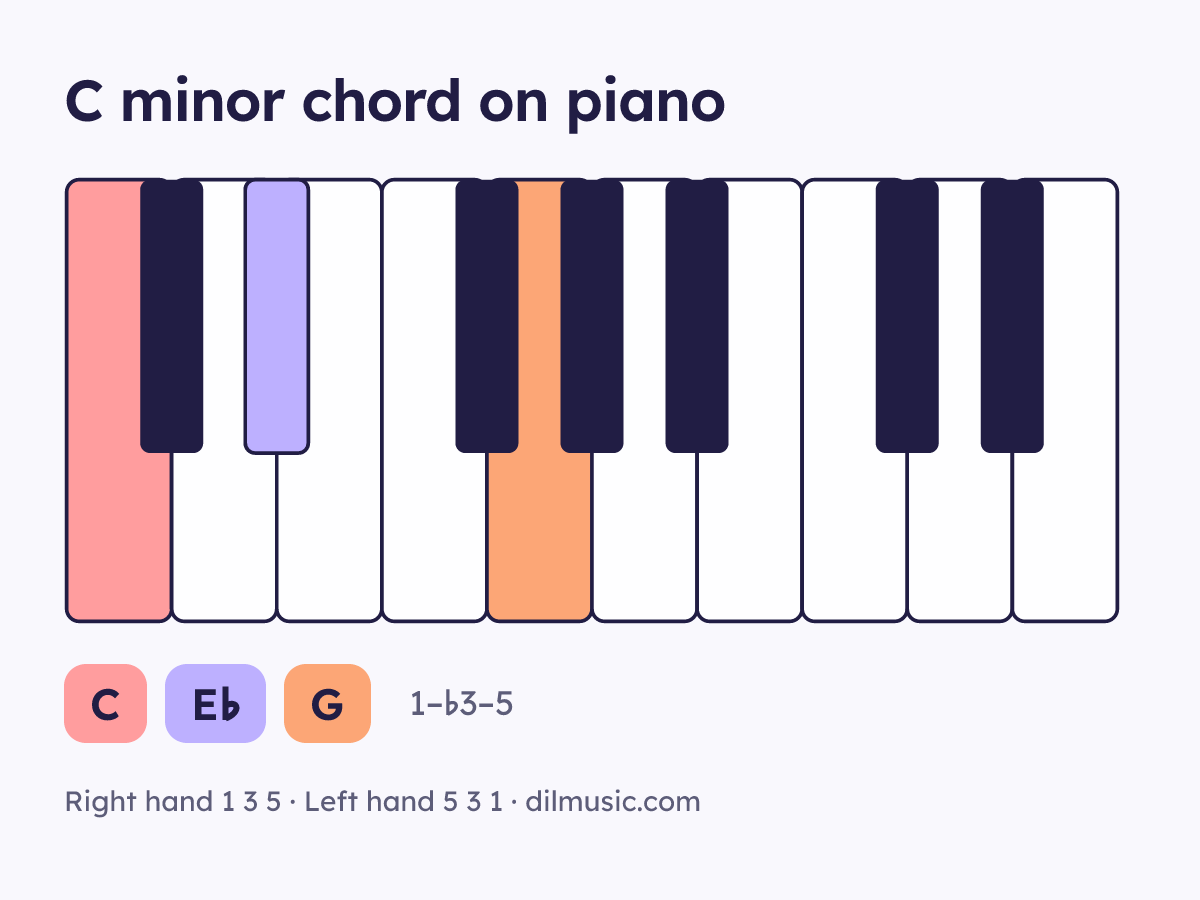
The Cm piano chord (C minor) is three notes: C, E♭ and G. Start on C, count three half steps up to E♭, then four more to G.
- Croot, 1
- E♭minor 3rd, ♭3
- Gperfect 5th, 5
Fingers are numbered from the thumb, 1, to the little finger, 5. Right hand 1, 3, 5; left hand 5, 3, 1.
How to play C minor on piano
- Find C, the white key just left of a group of two black keys.
- Put your right thumb (finger 1) on C.
- Count three half steps up, black and white keys alike, to E♭. Rest your middle finger (3) there.
- Count four more half steps to G for your little finger (5).
- Press all three keys together.
- For the left hand, play the same keys with fingers 5, 3 and 1, or play C an octave lower with your little finger.
Inversions
Root position
C, E♭, G
Right hand 1, 3, 5; left hand 5, 3, 1.
1st inversion
E♭, G, C
Right hand 1, 2, 5; left hand 5, 3, 1.
2nd inversion
G, C, E♭
Right hand 1, 3, 5; left hand 5, 2, 1.
Practice C minor
Hold each position of C minor for four beats, then move to the next: root position, 1st inversion, 2nd inversion, and round again. Start at 60 beats a minute and move up toward 100 once every change lands on the beat.
- Root positionC–E♭–G
- 1st inversionE♭–G–C
- 2nd inversionG–C–E♭
Press Start. After four clicks, play along as each position lights up on the keyboard. Tick Speed up each round to add 5 beats a minute after every round.
Quiz: find the notes
Press the keys of C minor, in any octave, then check.
The shape of C minor
C minor is white, black, white: E♭ is the only black key. F minor and G minor have the same pattern.
C minor is built from the C natural minor scale: take its 1st, 3rd and 5th notes, skipping every other note.
- C1
- D2
- E♭3
- F4
- G5
- A♭6
- B♭7
Smooth changes from C minor
Jumping from one root position chord to the next moves the whole hand. The right inversion keeps shared notes still and moves the others the shortest way. Below are the chords built on the 4th and 5th notes of C minor's own key: Fm and G.
From Cm to Fm, play Fm in 2nd inversion (C–F–A♭): C stays, E♭ moves up two half steps to F and G moves up a half step to A♭.
From Cm to G, play G in 1st inversion (B–D–G): C moves down a half step to B, E♭ moves down a half step to D and G stays.
C minor on the staff and on guitar
Progressions that use it
i–VI–III–VII, in C minor
- iCm
- VIA♭
- IIIE♭
- VIIB♭
i–iv–v, in C minor
- iCm
- ivFm
- vGm
i–VII–VI–V (Andalusian cadence), in C minor
- iCm
- VIIB♭
- VIA♭
- VG
iiø7–V7–i, in C minor
- iiø7Dm7♭5
- V7G7
- iCm
Related chords
Hearing a chord you can't name? Press its keys in the chord identifier.
Save or print the C minor chord chart
Practice notes for C minor
C minor is white, black, white: C and G are white, and the middle note is E♭, the black key. It is C major with one note moved, the E down to E♭, which makes it the easiest way to hear what minor means.
Where it goes wrong. The middle finger lands on E out of habit from C major. Before you press, look at the black key just left of E: that is E♭, the second black key of the group of two. The shape is the same as F minor and G minor, so the habit is worth building.
How to practice it. Play C major, then C minor, then C major again. Only the middle finger moves. Then practice the change to F minor in 2nd inversion (C–F–A♭): the thumb stays on C, the middle finger goes up to F, and the little finger to A♭.
What to listen for. The change from C major to C minor is one half step, but the sound shifts from bright to shaded. Try it slowly, holding each chord until it fades.
What to learn next. F minor and G major, the iv and V chords in C minor. The G major uses B, the raised 7th note of the key, and that B is what makes the progression lead back to C minor.
Questions
What notes are in a C minor chord?
C, E♭ and G. C is the root, E♭ is a minor 3rd above it and G is a perfect 5th above it.
How is C minor different from C major?
Only the middle note changes. C major raises E♭ a half step to E; the other two notes stay.
What does Cm mean?
The small m means minor: Cm is C minor, C, E♭ and G. You may also see it written Cmin or C−.